
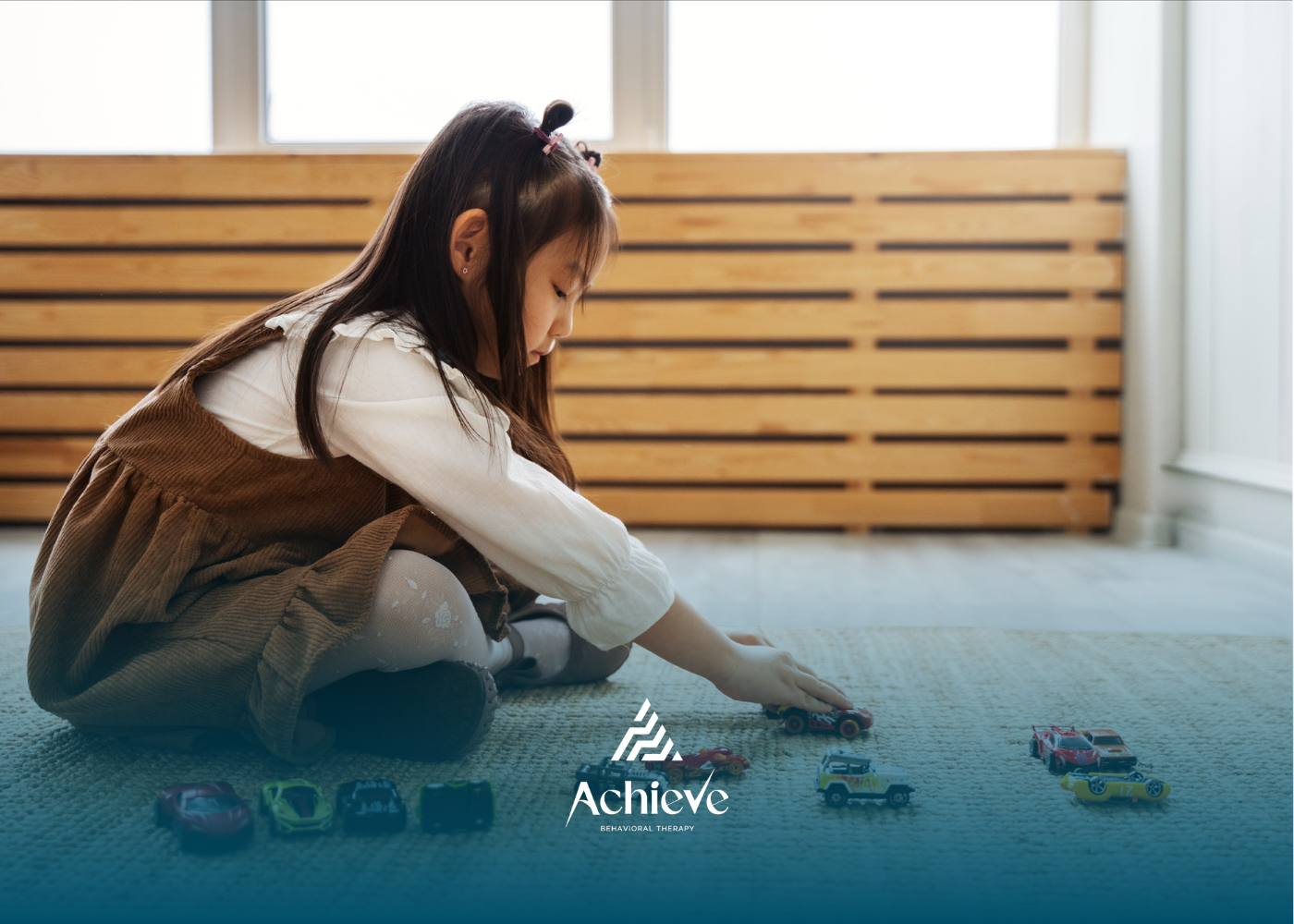


Why Do Kids with Autism Line Up Toys?

Many kids with autism line up toys because it provides a sense of order, predictability, and control. This repetitive behavior—often called a “restricted or repetitive pattern”—can help them manage sensory input or reduce anxiety. Arranging toys in straight lines or patterns might also be a way to focus attention and find comfort in structure.
Predictable arrangements can feel calming.
Lining up toys in a specific way can create a sense of structure and predictability, which may help a child feel more comfortable.
Repeating shapes or sequences can be satisfying.
Children may enjoy seeing toys arranged by color, size, or shape, finding pleasure in symmetry and repetition.
Details stand out in unique ways.
Lining up toys can highlight visual details like spacing, alignment, or small differences that are interesting to observe.
How things look can matter more than pretend play.
Some children are more drawn to organizing or examining toys rather than using them in imaginative or story-based play.
Arranging toys can feel empowering.
Organizing toys allows a child to control their environment, which can feel reassuring—especially during times of stress or change.
The activity itself can be calming.
Repeating the same action can help regulate emotions and reduce overwhelm.
Small differences really stand out.
Minor variations between toys—like wheels, faces, or colors—may naturally invite sorting or lining up.
It’s important to understand that these behaviors aren't “wrong.” Instead, they reflect how a child processes and interacts with their environment. Parents can gently introduce play-based strategies that encourage flexibility, such as joining their child’s play, adding small changes, or modeling new ways to use toys.
At Achieve Behavioral Therapy, our ABA therapists help children expand play skills while respecting their need for structure, promoting both creativity and comfort.
Frequently Asked Questions
Is lining up toys a sign of autism?
It can be, but it’s only one possible behavior among many.
Should parents stop this behavior?
No, instead of stopping it, guide and expand play naturally.
Can ABA therapy help with repetitive play?
Yes, ABA helps children build flexible play and social interaction skills.
Sources:
- https://pmc.ncbi.nlm.nih.gov/articles/PMC5538881/
- https://educationonline.ku.edu/community/restricted-and-repetitive-behavior-patterns-in-autism-spectrum-disorder
Need Support?
We're Here to Help!
Our experienced team is ready to assist you. Reach out today to discuss how we can support your child's development and well-being.
Get started with expert ABA therapy today.